


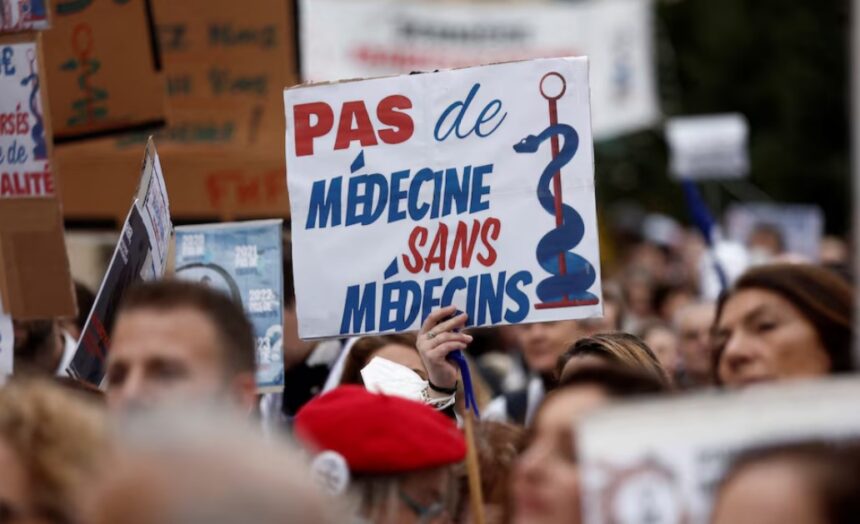
PARIS, July 5 – The rise of the far-right National Rally (RN) in France is prompting North African doctors like Tasnime Labiedh to consider leaving the country. Labiedh, a Tunisian doctor working in southern France, fears the political shift after RN secured 41% in the first round of the legislative elections. Concerned about the potential leadership of RN president Jordan Bardella, she contemplates moving to Switzerland.
Labiedh moved to France in 2021 during the COVID-19 pandemic for her medical internship and now works as a microbiologist, earning less than her French counterparts. The RN’s electoral success has caused some foreign-origin doctors to question their future in France, feeling unappreciated and unwelcome. Polls predict RN will win the largest share of seats in parliament but not a majority.
Among 11 North African doctors interviewed by Reuters, six are considering emigration due to the political situation. One doctor already emigrated to Canada last month. France faces a severe doctor shortage, with only 3.17 doctors per 1,000 inhabitants, the worst among OECD countries after Luxembourg. In Labiedh’s town, the ratio is even lower at 1.73 doctors per 1,000 inhabitants.
Sociologist Hicham Benaissa of France’s national scientific research center, CNRS, highlights the contradiction in France’s immigration policies. “The far right prospers on immigration issues, depicting migrants as a problem. Yet, if migrants stopped working, our social and economic system would collapse,” Benaissa explained. His upcoming study on 350 North African doctors in France indicates that 75% are considering emigration. The RN did not respond to requests for comment.
Bardella has reassured that foreign nationals who work, pay taxes, respect the law, and love France have nothing to fear. However, RN leader Marine Le Pen has proposed reducing the employment of non-EU qualified doctors and prioritizing French candidates.
In 2023, 29,238 doctors in France were trained outside the EU, a 90.5% increase since 2010, accounting for around 7% of the workforce. North African doctors make up more than half of this group. These doctors undergo extensive exams and administrative procedures to register with the Order of Doctors, a process taking three to five years, during which they are paid less than their French counterparts.
Widad Abdi, a doctor and SNPADHUE union representative for non-EU qualified doctors, criticizes politicians for ignoring structural issues. “The health system does not encourage doctors to stay due to poor working conditions, low pay, long hours, and increased patient loads,” Abdi said.
The RN’s success correlates with regions suffering from poor healthcare access, known as “medical deserts.” In areas where RN candidates led, over a quarter of the population lacks access to a local doctor, compared to 13% in towns supporting President Emmanuel Macron’s group and 8% in left-wing alliance towns. Foreign and immigrant-origin French doctors are crucial in these underserved areas, often filling less prestigious posts.
In Ales, southern France, where the RN secured half the vote, Moroccan A&E doctor Leila Elamrani notes the pressure on their service due to patients lacking general practitioners and an aging population. French doctor Lydia Boumaarafi, of Algerian heritage and specialized in addictology, recently moved to Canada, partly due to its multicultural approach. “The situation has climaxed with the RN vote, but the climate has been tense for a while,” she remarked.