




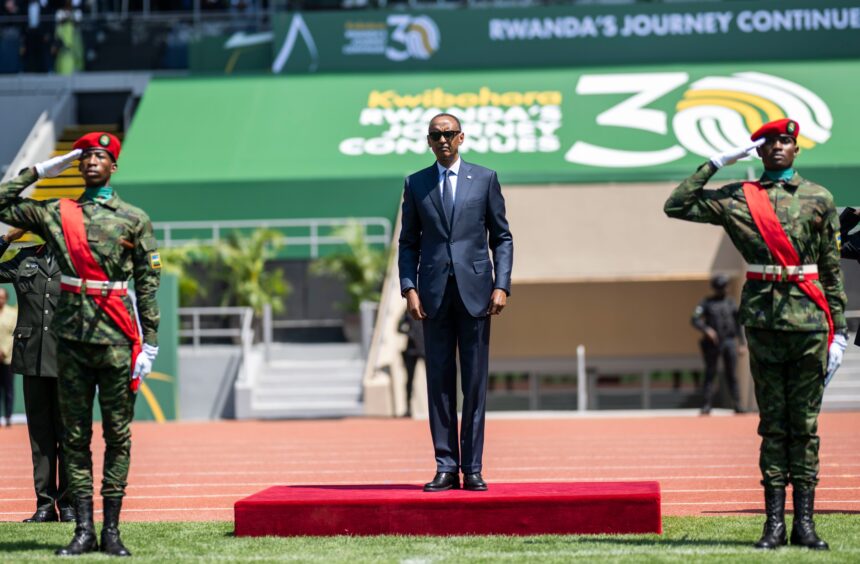
Incumbent President Paul Kagame has secured a decisive victory in Rwanda’s national elections held on July 15, with the National Electoral Commission reporting a voter turnout of 98%. With 79% of ballots counted, Kagame leads with over 99% of the vote, far ahead of his opponents, Frank Habineza of the Democratic Green Party of Rwanda, and independent candidate Philip Mpayimana, who garnered 0.53% and 0.32%, respectively.
Kagame, in power since 2000, is poised to begin his fourth term, continuing his leadership following a similarly overwhelming win in 2017, where he captured nearly 98.79% of the vote. His tenure has been marked by significant economic growth, with Rwanda’s GDP rising from $752 million in 1994 to $14 billion in 2024. However, this economic prosperity has not been evenly distributed, as more than half of Rwanda’s population lives on less than $1.90 a day.
Despite his international acclaim for bringing stability and economic growth to Rwanda, Kagame’s regime has been criticized for its authoritarian approach. Key opposition figures, including Diane Rwigara, Bernard Ntaganda, and Victoire Ingabire, were barred from participating in the elections due to various alleged infractions. Both Rwigara and Ingabire have faced imprisonment on charges widely viewed as politically motivated, creating an electoral environment with little genuine competition.
Observers from organizations such as the East African Community and the African Union have praised the peaceful conduct of the elections and the diligence of the National Electoral Commission. However, their joint statement notably omitted any mention of the disqualified opposition candidates.
Kagame’s extended rule has been facilitated by constitutional changes enacted by his party, the Rwanda Patriotic Front (RPF). A 2015 referendum allowed Kagame to seek a third seven-year term, and subsequent reforms have introduced a two-term limit starting with the recent election, permitting Kagame to potentially remain in power until 2034. These changes have drawn criticism from the US and the EU, although Kagame insists they reflect the will of the Rwandan people.
Critics argue that these constitutional amendments contravene Article 23(5) of the African Charter on Democracy, Elections, and Governance, which prohibits extending presidential terms. Despite this, the African Union has largely ignored these violations.
Kagame’s continued presidency also has implications for regional stability, particularly regarding relations with the Democratic Republic of Congo (DRC). Over the past two years, tensions have escalated due to allegations that Rwanda is supporting the M23 rebels destabilizing eastern DRC. A recent UN report claims that 3,000 to 4,000 Rwandan troops are aiding M23, accusations that Rwanda denies.
Hostile exchanges between Kagame and DRC President Felix Tshisekedi have further strained relations. Kagame recently declared that Rwandan forces are prepared to fight, while Tshisekedi has accused Kagame of harboring hostile intentions and has threatened military action if diplomatic efforts fail.


