


Johannesburg, South Africa – As South Africa gears up for crucial elections this month, the ruling African National Congress (ANC) finds itself grappling with a stark reality: record-high unemployment and a disillusioned electorate. The ANC, which has held power for three decades, is struggling to paint a rosy picture of its governance amid growing discontent.
Dalene Raiters, a 48-year-old resident of Johannesburg, epitomizes the sentiments of many struggling South Africans. In a cramped single room she shares with her sons and grandson, Raiters expresses her frustration with the ANC, lamenting that “Mandela’s dream is not their dream.”
The ANC has long touted South Africa’s welfare system as a crowning achievement, but for Raiters and millions like her, it falls short of addressing the root issues. President Cyril Ramaphosa lauds government programs as investments in the future, yet the reality on the ground tells a different story.
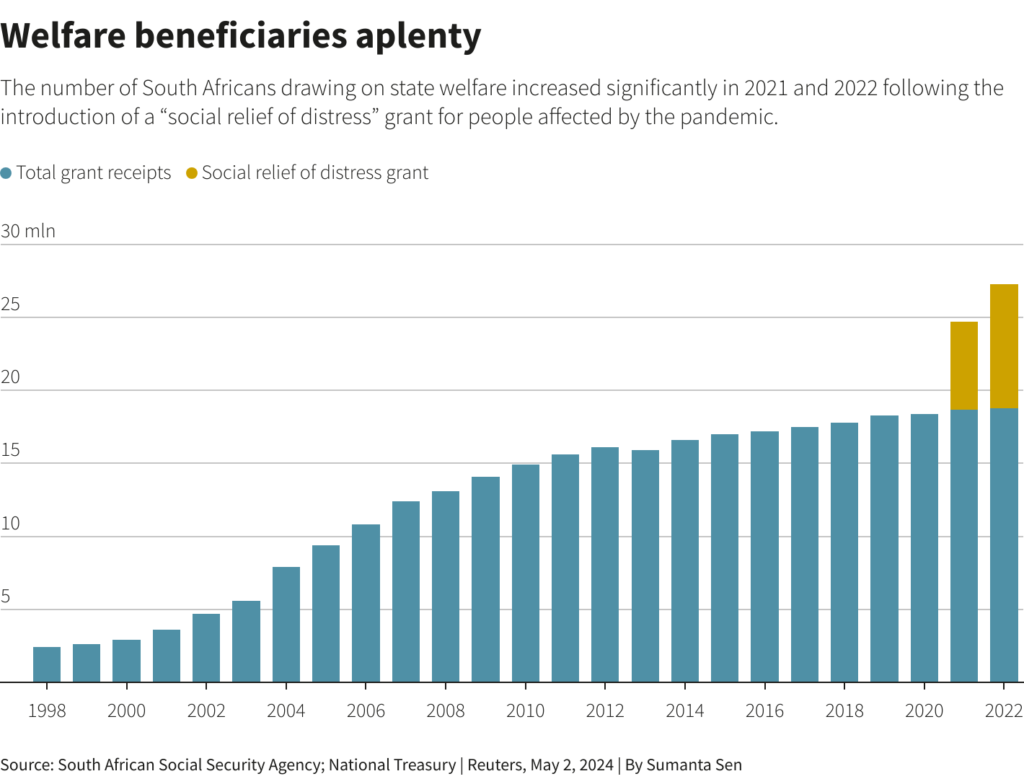
With over 24 million people relying on social assistance in a country with a tax base of just 7.1 million, the strain on the welfare system is evident. The ANC’s future hangs in the balance as it faces stiff competition from opposition parties like the Economic Freedom Fighters (EFF) and the Democratic Alliance (DA), each with contrasting visions for the country’s future.
The ANC’s once-proud legacy of social security and economic prosperity has crumbled under the weight of staggering poverty rates and rampant unemployment. Despite lofty promises, more than 60% of South Africans live in poverty, while unemployment has soared above 32%.
For Raiters, who lost her job 16 years ago, the meager government grants barely sustain her family. The temporary pandemic relief measures, extended against expert advice, offer little solace to those like Raiters, who yearn for meaningful employment rather than handouts.
As the ANC faces the prospect of losing its majority, potential coalition partners loom large. The DA, with its focus on job creation and market-friendly policies, presents an uneasy alliance for the ANC. Meanwhile, the EFF’s radical agenda of land redistribution and nationalization of key industries sends shivers down the spines of investors.
Economists warn that the current welfare-centric approach is unsustainable in the face of mounting unemployment and economic stagnation. Michael Sachs of the Southern Centre for Inequality Studies emphasizes the urgent need for a shift towards inclusive economic growth rather than reliance on welfare handouts.
For Raiters, the solution lies not in more welfare benefits but in meaningful employment opportunities for future generations.