




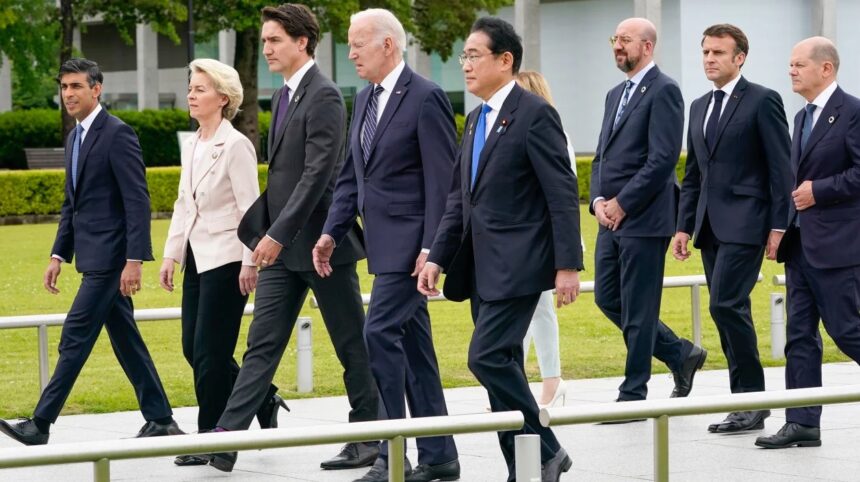
Hiroshima – US President Joe Biden emphasized the crucial role of the Indo-Pacific region in shaping the future of the world during the G7 summit held in Hiroshima, Japan. In a significant move, Biden convened a meeting with the leaders of the Quadrilateral Security Dialogue (QUAD) – Australian Prime Minister Anthony Albanese, Japanese Prime Minister Fumi Kishida, and Indian Prime Minister Narendra Modi. Together, they discussed strategies to counterbalance and limit China’s growing influence in the Indo-Pacific region.
Biden reaffirmed the shared mission of the QUAD alliance, which encompasses the United States, Australia, Japan, and India, to promote a free, open, secure, and prosperous Indo-Pacific. “Our mission remains the same. To advance our vision of a free, open, secure, and prosperous Indo-Pacific region,” Biden stated, underscoring the continued commitment of his administration to the QUAD’s objectives.
The Indo-Pacific region has gained increasing significance due to its economic vitality and geopolitical importance. As China’s influence expands, the QUAD seeks to maintain a balance of power and uphold international norms and principles in the region. The alliance focuses on fostering cooperation in areas such as maritime security, counterterrorism, cybersecurity, and infrastructure development.
President Biden’s decision to meet with the QUAD leaders during the G7 summit highlights the United States’ dedication to addressing the challenges posed by China’s rise. The meeting provided an opportunity for the leaders to strategize and coordinate efforts to ensure a stable and rules-based regional order.
The Biden administration has made the Indo-Pacific region a priority, recognizing the impact it holds on global affairs. By strengthening partnerships with countries in the region, the United States aims to promote democratic values, human rights, and sustainable economic growth.
During the G7 summit, the participating leaders also discussed broader issues, including climate change, the global economic recovery, and the ongoing COVID-19 pandemic. The Quad leaders expressed their commitment to collaborative efforts in these areas, emphasizing the importance of multilateral cooperation in addressing global challenges.
The meeting between President Biden and the QUAD leaders serves as a testament to the growing recognition of the alliance’s significance in shaping regional dynamics. As the QUAD continues to develop and strengthen its cooperation, it will play a pivotal role in ensuring a stable and prosperous Indo-Pacific region.
The G7 summit in Hiroshima concluded with a joint commitment to work collectively towards a safer, more sustainable, and inclusive world. The QUAD leaders expressed their gratitude for the hospitality extended by the Japanese government and reiterated their commitment to maintaining a free, open, and prosperous Indo-Pacific region.
As the Indo-Pacific region becomes increasingly vital to the global order, the collaborative efforts of the QUAD alliance, with the support of the United States, will likely shape the geopolitical landscape in the years to come.


