




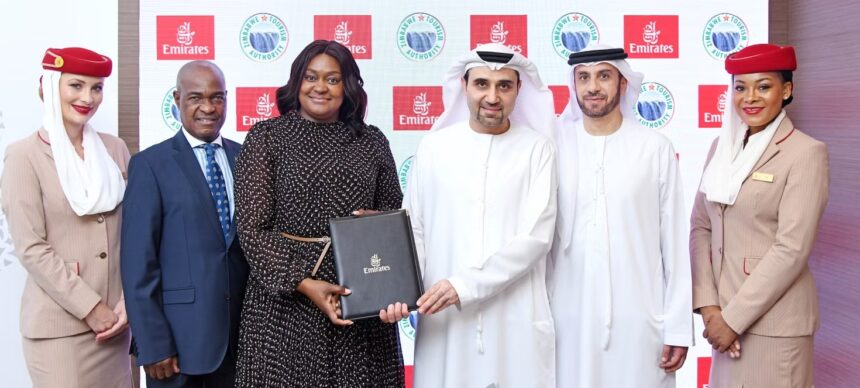
Emirates Airlines has signed a Memorandum of Understanding (MoU) with the Zimbabwe Tourism Authority (ZTA) to enhance tourism and attract inbound traffic by utilizing its global network. The agreement was signed by Badr Abbas, Emirates’ Senior Vice President of Commercial Operations for Africa, and Ms Winnie Munchanyuka, the ZTA Chief Executive, in Dubai.
According to the MoU, the two parties will initiate various marketing campaigns to promote leisure activities and showcase Zimbabwe’s tourist attractions. Additionally, they will organize familiarization trips for trade and media, and explore opportunities for combined advertising campaigns.
Badr Abbas commented that Zimbabwe is a popular destination in Southern Africa, with thousands of tourists visiting annually to see attractions such as Victoria Falls, the world’s largest curtain of free-falling water, Lake Kariba, the world’s largest man-made lake, and other attractions. Ms Munchanyuka also added that the agreement is a significant step towards increasing tourist traffic to Zimbabwe.
Emirates launched its operations between Dubai and Harare in September 2012 with five weekly flights. Due to the increase in demand, the airline now operates seven weekly Boeing 777 flights to Harare Robert Mugabe Airport (HRE), linked to Lusaka, Zambia.
Over the past 11 years, the HRE-DXB route has been traveled by numerous passengers seeking to visit the UAE and other destinations offered by Emirates. The airline has also played a crucial role in driving significant traffic to Zimbabwe from Asia, Europe, the Middle East, and North America.
Emirates has codeshare agreements with Airlink and South African Airways, providing more connectivity to passengers and giving customers access to domestic points like Bulawayo and Victoria Falls.
The MoU signed between Emirates and the Zimbabwe Tourism Authority is a significant step towards promoting tourism in Zimbabwe and increasing its exposure to the global market. The two parties’ joint efforts to market Zimbabwe’s attractions will undoubtedly contribute to increasing the country’s tourism revenues in the coming years.

 with the Zimbabwe Tourism Authority (ZTA) to enhance tourism and attract inbound traffic by utilizing its global network.)