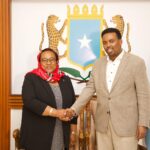


Accra, Ghana – Naana Jane Opoku-Agyemang made history as Ghana’s first female vice president following the reelection of former President John Dramani Mahama in December 2024. This landmark achievement positions the West African country closer to potentially electing its first female president, a milestone already reached by Namibia with the election of Netumbo Nandi-Ndaitwah.
Opoku-Agyemang, 73, a professor and former Minister of Education, expressed that her appointment is not just a personal victory but a win for women, youth, and the broader population. She emphasized her commitment to opening doors for others to follow, especially women, in politics and leadership.
Her appointment reflects a broader trend of increasing gender equality in leadership roles across Africa. Despite Ghana’s 51% female population, women hold only 14.5% of parliamentary seats, far below the global average. However, Opoku-Agyemang’s rise to vice president is seen as a significant step in addressing this disparity.
Ghanaian singer Efya (Jane Awindor) noted that this development would likely inspire more women to pursue political careers and leadership roles. “It reflects the growing recognition of women’s capabilities and contributions to governance,” she said in an interview with Forbes Africa.
Opoku-Agyemang’s career is marked by several firsts. In 2008, she became the first female Vice-Chancellor of the University of Cape Coast, and she served as Minister of Education from 2013 to 2017. Although her previous vice-presidential bid in 2020 was unsuccessful, her current role as vice president solidifies her position as a key figure in Ghana’s political landscape.
Despite these advancements, there are still pockets of resistance within Ghanaian society. Some voters hesitated to support Mahama due to Opoku-Agyemang’s nomination, reflecting cultural barriers to women in top political positions. Entrepreneur Bernard Agbonoshie described her appointment as a major win for gender inclusivity, suggesting that Ghanaians are increasingly ready to embrace female leadership.
Ghana’s gender dynamics have evolved in recent years, with the country rising 12 spots in the 2024 Global Gender Gap Report to rank 88th globally. A 2022 survey by Afrobarometer showed that 67% of Ghanaians support equal political participation for women.
Across Africa, other nations are also advancing women in leadership. Rwanda leads with 61.3% female representation in parliament, while Tanzania’s President Samia Suluhu Hassan and Namibia’s President Netumbo Nandi-Ndaitwah further showcase the growing impact of women in leadership roles.