




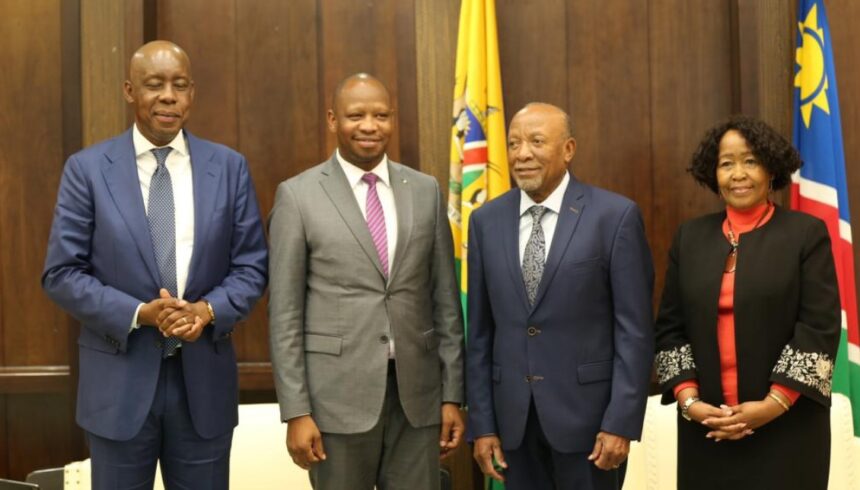
Windhoek, Namibia – This morning in Windhoek, Joshua Setipa, a candidate for the position of Secretary-General of the Commonwealth, and Hon. Lejone Mpotjoane, Minister of Foreign Affairs and International Relations, were warmly welcomed by His Excellency Dr. Nangolo Mbumba, President of the Republic of Namibia. The delegation delivered a special message from the Prime Minister of Lesotho, Rt. Hon. Sam Matekane, endorsing Setipa’s candidacy for the Commonwealth’s top position.
In an interview with the media, Setipa introduced himself and highlighted the significance of his candidacy. “The Commonwealth heads of state will convene in October to elect the next Secretary-General, succeeding the current officeholder who has completed an eight-year term,” Setipa stated. He emphasized the importance of Africa presenting a strong candidate, noting that the last African Secretary-General was Chief Emeka Anyaoku from 1990 to 2000.
Setipa outlined that three candidates are vying for the position: one from Ghana, one from Gambia, and himself from Lesotho. He expressed confidence in his candidacy, backed by the endorsement of the Southern African Development Community (SADC). The visit to Namibia was part of his efforts to understand the country’s expectations and how the Commonwealth can support Namibia, especially with upcoming elections in November and challenges such as unemployment and climate change.
“If elected, I will focus on ensuring that Namibia receives the support it needs from the Commonwealth,” Setipa affirmed. He also stressed the importance of regional cooperation, highlighting that 12 out of 16 SADC member states are Commonwealth members, with Zimbabwe possibly rejoining by the end of the year.
Setipa discussed the Commonwealth’s diverse membership, comprising 56 countries with a combined population of 2.5 billion, from the largest, India, to the smallest, Pacific nations. He emphasized the Commonwealth’s role in pooling resources to help member states tackle various challenges, including human rights, democracy, and peace.
Regarding regional conflicts, Setipa acknowledged the ongoing tensions in the Democratic Republic of Congo (DRC) and other areas. He promised that the Commonwealth would continue supporting member states in addressing these issues, working with partners to bring stability and solutions to the region’s challenges.
Energy poverty was another critical issue addressed by Setipa. He mentioned the Commonwealth’s efforts to enhance member countries’ capacity to attract investments in renewable energy and sustainable mining, particularly in Namibia. “We aim to achieve energy security and help countries transition towards more sustainable energy sources,” he said.
Setipa concluded by noting the upcoming Commonwealth Heads of Government Meeting in Samoa, a region significantly impacted by climate change. “Energy transition and security will be major topics of discussion, as we mobilize global support to assist our member states,” he said.


