


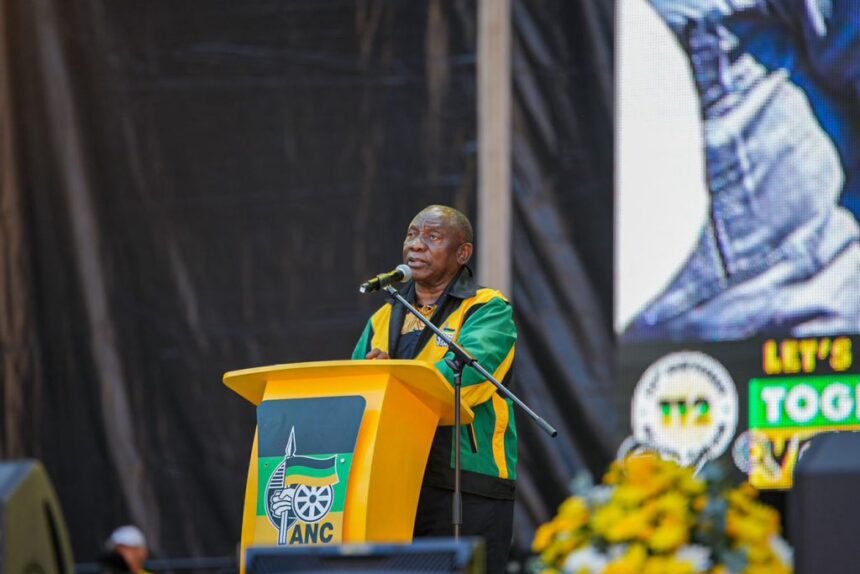
JOHANNESBURG — South Africa’s leading political parties launched their final campaigns this weekend ahead of a pivotal election that may bring the most significant political shift in 30 years.
The African National Congress (ANC), which has governed since the end of apartheid in 1994, held a major rally at a soccer stadium in Johannesburg. Party leader and President Cyril Ramaphosa addressed thousands of supporters clad in the ANC’s signature black, green, and gold, acknowledging the issues that have eroded the party’s support, including widespread poverty and unemployment affecting the Black majority.
“We have a plan to get more South Africans to work,” Ramaphosa assured the crowd. “Throughout this campaign, our people have shared their struggles to find work and provide for their families.”
Recent polls suggest the ANC’s support has dipped below 50%, which could force it to form a national coalition—a first in South Africa’s democratic history. This election marks a potential turning point for the party that Nelson Mandela once led, as it faces unprecedented pressure to maintain its parliamentary majority.
Meanwhile, the main opposition Democratic Alliance (DA) rallied in Cape Town, led by John Steenhuisen. Addressing supporters wielding blue umbrellas, Steenhuisen energized the crowd with calls for change. “Are you ready to rescue South Africa?” he asked, receiving a resounding “Yes!” in reply.
Despite the ANC’s declining support over the past three elections, no single party has emerged to challenge its dominance. However, losing its majority would signify a significant rejection of the party that played a crucial role in ending apartheid.
ANC supporters at the Johannesburg rally voiced their frustrations over persistent issues such as poverty, unemployment, inequality, corruption, and crime. “We want to see job opportunities and general change in every aspect,” said Ntombizonke Biyela, an ANC supporter. “Since 1994 we have been waiting, but we see very little progress.”
The ANC, while admitting to some failures, maintains that South Africa is better off than during apartheid, citing improvements in social support and services for millions of poor South Africans in the post-apartheid decade.
“There are many problems in South Africa, but nobody can deny the changes since 1994, and that was because of the ANC,” said Eric Phoolo, a long-time supporter. “These other parties don’t have a track record of bringing change to the country.”
The political landscape has fractured as some voters shift their support to various opposition parties, leading to a diversification of political allegiances. South Africa’s proportional representation system means that parties receive seats in Parliament according to their share of the vote, and the majority party elects the president. If the ANC loses its majority, Ramaphosa’s re-election bid could be jeopardized, necessitating coalition agreements to secure the necessary parliamentary votes.
The far-left Economic Freedom Fighters (EFF), led by Julius Malema, held their final rally in Polokwane, while the new MK Party, founded by former President Jacob Zuma, campaigned near Durban. Zuma, who has turned against the ANC and criticized Ramaphosa, did not attend the event due to his disqualification from running for Parliament because of a prior criminal conviction.