


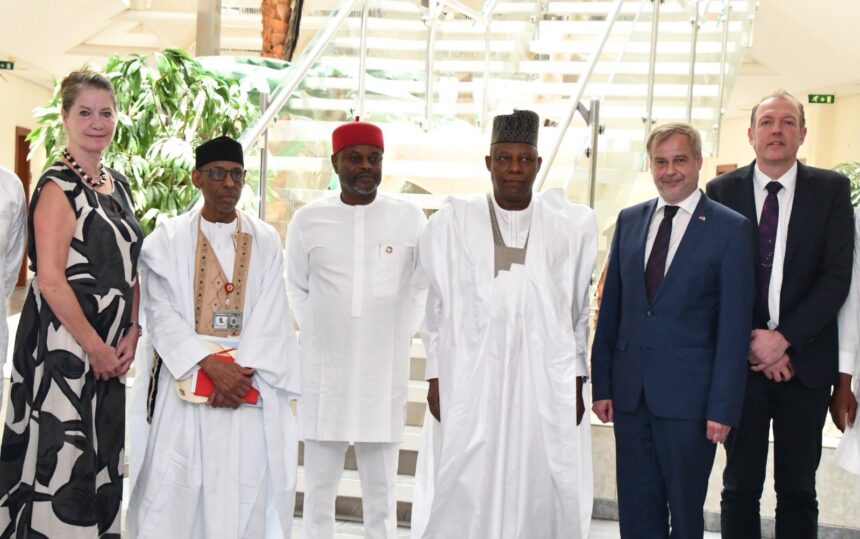
Nigeria and Germany struck a deal to collaborate on developing the African nation’s green hydrogen sector, aiming to unlock a share of the projected $130 billion global market.
Vice President Kashim Shettima received a German delegation led by member of Parliament and Hydrogen Commissioner Till Mansmann on Friday. Shettima emphasized Nigeria’s commitment to transitioning from fossil fuels to clean energy sources, acknowledging the urgency of addressing climate change.
The partnership aligns with Nigeria’s renewable energy goals and the global shift towards a sustainable future. Shettima expressed confidence that Nigeria’s success in this field could serve as a model for the entire African continent.
“Hydrogen has the potential to revolutionize many industries in Nigeria,” Shettima said, highlighting its possible use in fertilizer production. He emphasized the importance of collaboration between Nigerian and German institutions, including the Federal Ministry of Science and Technology and the University of Nigeria, Nsukka (UNN).
Germany sees Nigeria as a crucial partner in its National Hydrogen Strategy and its transition to carbon neutrality by 2045. Mansmann acknowledged Germany’s reliance on fossil fuel imports and its goal of complete transition to green energy sources within the next two decades.
“Nigeria is a very important partner for the global transformation of energy,” Mansmann said. “We need to come together in cooperations in technology, science and human resources.”
Nigeria’s vast potential for green energy production, particularly hydrogen, was a key driver behind the agreement. Germany’s expertise in research and development, coupled with Nigeria’s abundant resources, positions the partnership for significant progress.
The collaboration extends beyond government entities, with both parties recognizing the crucial role universities play in fostering innovation and developing future talent. Mansmann’s visit to UNN highlighted ongoing efforts in the field of renewable energies, paving the way for potential joint ventures and knowledge exchange.