

Russian President Vladimir Putin has officially commenced his fifth term in office at the Kremlin, as he took the oath of office amidst notable absences from key Western nations including the United States, the United Kingdom, and various European Union members.
Despite securing a commanding 87.28 percent of the vote in March, Putin’s reelection faced substantial criticism over its democratic integrity, particularly following the death of opposition figure Alexey Navalny in custody shortly before the elections.
In a clear diplomatic statement, the United States, the United Kingdom, and Canada opted to abstain from sending representatives to the inauguration ceremony. This decision was echoed by the majority of European Union member states, according to a spokesperson for the European Union.
The Baltic states, comprising Estonia, Latvia, and Lithuania, further underscored their disapproval by withdrawing their ambassadors from Moscow and rejecting any participation in the inauguration. Lithuania’s Foreign Minister Gabrielius Landsbergis emphasized the importance of isolating Russia, declaring, “Participation in Putin’s inauguration is not acceptable for Lithuania.”
Similarly, the Czech Republic and Germany maintained their stance of non-participation, with Germany having previously recalled its ambassador over allegations of Russian cyberattacks.
Despite the notable boycotts, all foreign diplomatic missions in Moscow, including those from “unfriendly states,” received invitations to the ceremony, as confirmed by an aide to Putin. The event, which commenced at noon (09:00 GMT), was broadcast live on Russian television.
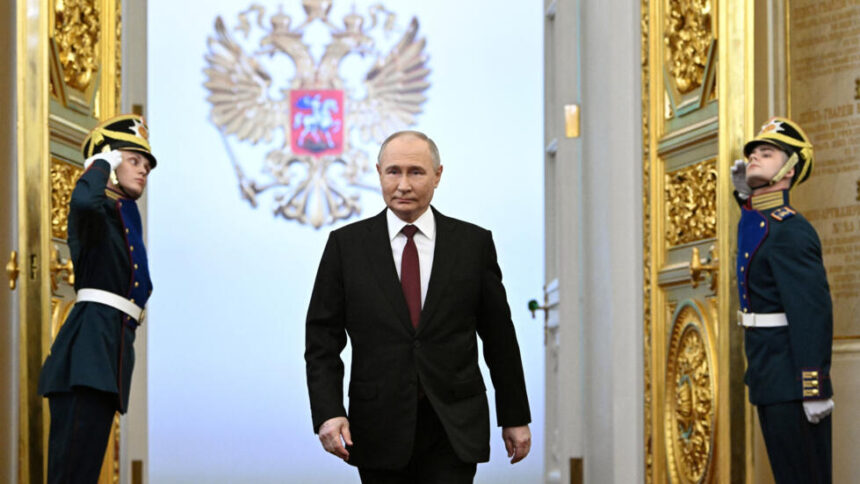
The inauguration ceremony saw Putin arrive at the Grand Kremlin Palace in a luxurious motorcade, followed by a procession through palace corridors to the Saint Andrew Hall, where he took the presidential oath and delivered a brief address. The ceremony concluded with a blessing from the patriarch of the Russian Orthodox Church.
Simultaneously, Russia announced plans for a tactical nuclear weapons drill, citing “provocative” actions by Western countries over Ukraine. In response, the Ukrainian Ministry of Foreign Affairs condemned the ceremony, labeling it an attempt to legitimize Putin’s prolonged tenure and denouncing Russia’s aggression.
Despite the notable absences, France, Hungary, and Slovakia sent representatives to the ceremony.