


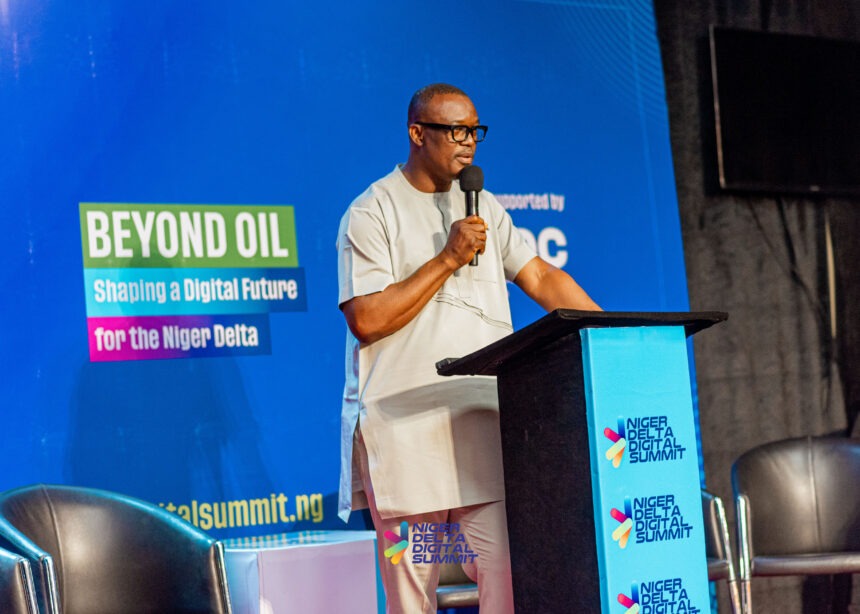
PORT HARCOURT, NIGERIA – Calls to shift the Niger Delta’s future beyond crude oil echoed strongly on Wednesday as regional leaders, innovators, and government officials gathered for the 2025 Niger Delta Digital Summit at the EUI Event Centre in Port Harcourt.
Themed “Beyond Oil: Shaping a Digital Future for the Niger Delta,” the summit focused on repositioning the region as a hub for technology-driven development. Delivering the keynote address on behalf of the Niger Delta Development Commission (NDDC), Assistant Director of Business Applications and Training, Patrick Isicheli, laid out a strategic blueprint built around three pillars: connectivity, capacity, and collaboration.

The event attracted hundreds of participants in-person and thousands online, with local startups, government representatives, and young innovators debating pathways to a digitally inclusive economy.

Isicheli challenged the region to take ownership of its digital evolution. “We can no longer afford to be bystanders in the digital revolution,” he said. “We must be pioneers.” He referenced the region’s transformation potential, pointing to successful tech events like the 2024 PH Tech Expo, which gathered nearly 300,000 virtual viewers and birthed the Port Harcourt Angel Network — a funding platform for regional startups.
Under the first pillar, connectivity, Isicheli said the NDDC is investing in expanding broadband infrastructure, with a target of achieving universal internet access by 2030. He described ongoing efforts to deploy solar-powered digital kiosks in rural areas and edge-computing hubs in cities like Port Harcourt to support real-time data processing and environmental monitoring.

For capacity building, Isicheli cited over a decade of digital training programmes run by the NDDC. Since 2012, more than 1,000 young people have been trained in computer literacy, data analysis, and web development. A new focus on advanced fields such as blockchain and artificial intelligence is already underway. He said many past beneficiaries have since become startup founders, contributing to the region’s growing digital economy.

On the collaboration front, the summit showcased success stories such as AGROVEST, a local agritech startup that won the 2024 Hackathon prize of ₦5 million. Isicheli stressed that partnerships between government, private sector, and local communities are critical to nurturing similar innovations. He mentioned efforts to attract tech giants to the region to support 5G rollout and IoT-based environmental solutions.

The vision, he said, is to transform the Niger Delta into a digital powerhouse by 2035 — a region where students code, entrepreneurs scale globally, and communities thrive through technology.

Speakers throughout the day called for deliberate inclusion of women in tech, new funding models for startups, and stronger policy frameworks to support innovation. “Crude oil damaged the land, but the digital future can heal it,” one panellist declared, drawing applause from a packed hall.
The summit concluded with a strong push for action over rhetoric, echoing a sentiment from the audience: “Digital summits are usually cosmetic without action — we must break that cycle.”