


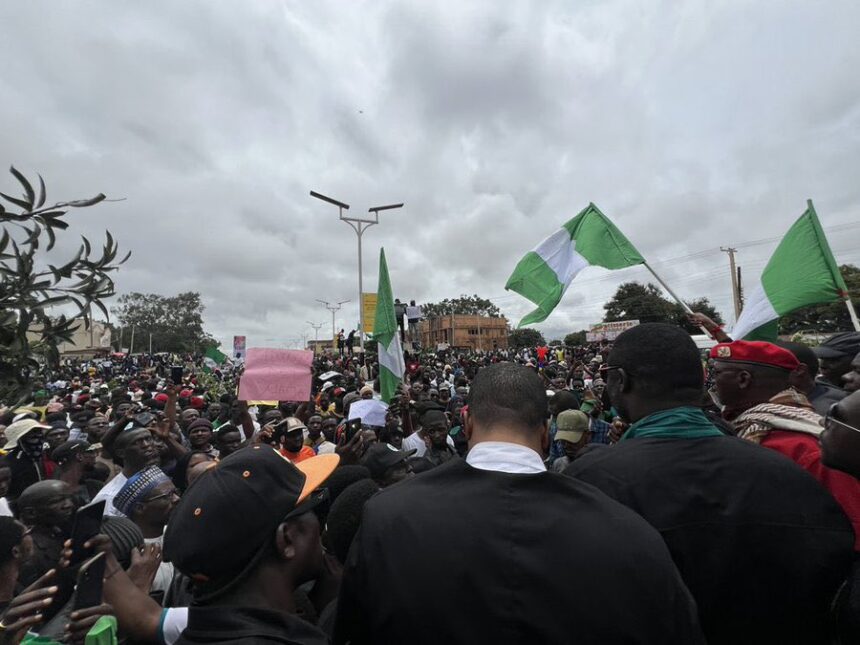
Lagos – At least three people lost their lives on Thursday as Nigerians took to the streets in multiple cities to denounce the escalating cost of living and the government’s handling of the economic crisis.
Protests erupted in the capital, Abuja, the commercial hub, Lagos, and other urban centers, with demonstrators expressing their anger over President Bola Tinubu’s economic reforms. These policies, including fuel subsidy removal, currency devaluation, and electricity tariff hikes, have ignited rampant inflation, eroding the purchasing power of ordinary citizens.
The Kaduna state police command confirmed the deaths, attributing the fatalities to clashes between protesters and security forces. While the police maintained that only tear gas was used to disperse crowds, eyewitness accounts suggest otherwise.
In Lagos, a heavy police presence was deployed to contain the demonstrations. Despite this, protesters managed to march towards the government house before being redirected to designated protest zones.
Inspired by recent protests in Kenya that compelled the government to reverse certain tax increases, Nigerians have united online, demanding the restoration of fuel and electricity subsidies, free education, and improved security.
The government, while expressing openness to dialogue, has urged citizens to endure the hardships associated with the reforms, arguing that they are necessary for the country’s long-term stability. However, critics contend that the burden of these policies falls disproportionately on the poor, while politicians enjoy relative immunity from the economic pain.
The situation is further compounded by a pervasive insecurity crisis that has crippled agriculture, a key sector of the economy. Kidnappings for ransom, particularly targeting students, have become commonplace in the northern regions.
While labor unions have led past protests, Thursday’s demonstrations were predominantly driven by unemployed youth, presenting a new challenge for the government. Although President Tinubu recently signed a new minimum wage law to alleviate the plight of workers, the measure is expected to have limited impact on the vast majority of Nigerians who are either self-employed or jobless.
The protests come as inflation soared to a 28-year high of 34.19% in June, exacerbating the economic hardship faced by millions of Nigerians.