


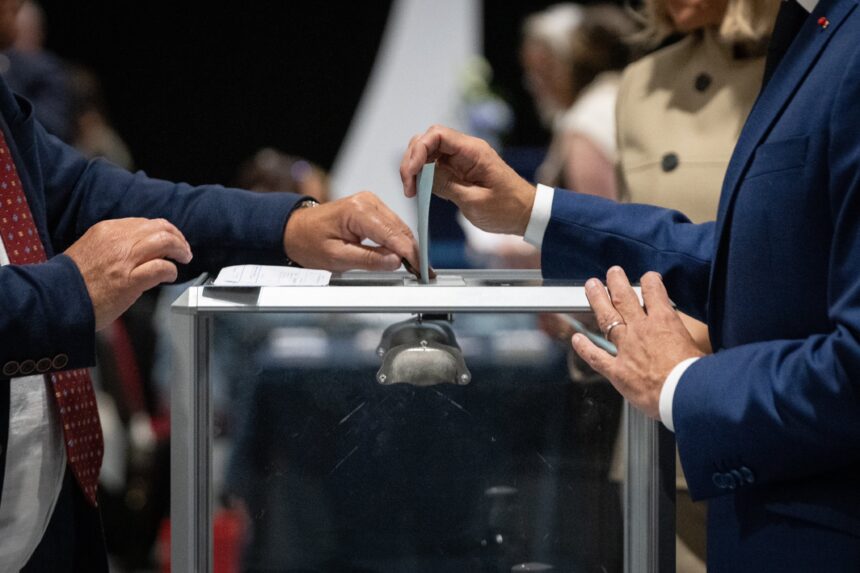
French voters participated in the initial round of a snap parliamentary election on Sunday, marking a pivotal moment that could see the far-right National Rally (RN) ascend to power for the first time since World War Two. The election was called by President Emmanuel Macron following a significant defeat of his centrist alliance in recent European elections, signaling a dramatic shift in France’s political landscape.
Polls opened early across the country and are set to close later in the day, with initial exit polls and seat projections expected to provide insights into the election’s trajectory. The complexity of France’s electoral system, however, means that final seat allocations will not be confirmed until voting concludes on July 7.
“We are going to win an absolute majority,” declared Marine Le Pen, leader of the RN, expressing confidence in her party’s prospects. Le Pen’s platform includes substantial economic spending and stringent immigration policies, marking a departure from the party’s previous marginal status to a formidable contender on the national stage.
In Garches near Paris, tensions flared as RN candidate Jordan Bardella cast his vote, prompting strong reactions from observers critical of the party’s inclusivity. Bardella himself remarked on the presence of left-wing voters at the polling site, underscoring deep-seated divisions within French society.
A potential victory for the RN would usher in a period of unprecedented political dynamics, with Macron and Bardella positioned as potential rivals in shaping France’s future. Historically, France has experienced periods of “cohabitation” when opposing political camps govern, but none with such stark ideological differences at the forefront.
Bardella has already indicated a willingness to challenge Macron on global issues, potentially reshaping France’s role within the European Union and its diplomatic engagements. Key areas of contention include demands for a renegotiation of France’s EU financial contributions and divergent views on EU unity and defense strategies.
Furthermore, the RN’s stance on international affairs, particularly concerning the Russia-Ukraine conflict, adds another layer of uncertainty to France’s foreign policy outlook. Le Pen’s mixed stance on Russia, balancing support for Ukraine with reservations about military aid, could alter France’s current European alliances.
Reflecting local sentiments in Hénin-Beaumont, a town pivotal to Le Pen’s constituency, voter Denis Ledieu highlighted economic hardships and openness to the RN’s promises of change. “If the (RN) promises them things, then why not? They want to try it out, I think,” Ledieu remarked, capturing the electorate’s readiness for political alternatives.
Early voter turnout figures indicated heightened engagement compared to previous elections, underscoring the significance of this election for French democracy. Opinion polls prior to the election suggested the RN maintained a lead with 33%-36% of the popular vote, followed by the New Popular Front coalition at 28%-31%, and Macron’s centrist alliance trailing behind.
Vincent Martigny, a political science professor, cautioned about the election’s unpredictability due to France’s electoral intricacies. He noted that split voting could advantage the RN, with runoff scenarios potentially altering the electoral landscape.