


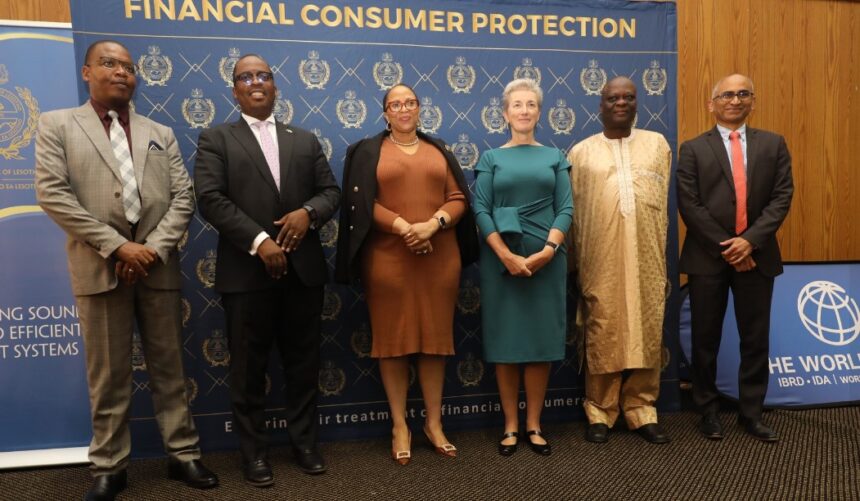
Lesotho’s financial sector is set for a boost thanks to a new technical assistance program launched this week. The initiative, a collaboration between the Central Bank of Lesotho (CBL), the Ministry of Finance and Development Planning, the European Union (EU), and the World Bank, aims to enhance financial stability and promote inclusive growth.
Lesotho’s Finance Minister, Dr. Rets’elisitsoe Matlanyane, welcomed the partnership, emphasizing the importance of coordinated support from development partners. She highlighted the need for a robust financial sector as the bedrock of a sound economy and expressed her hope for similar partnerships in other sectors.
The EU Ambassador, H.E. Paola Amadei, echoed the Minister’s sentiment, stressing the crucial role of a well-functioning financial system in fostering economic development and job creation. The EU’s €300,000 investment will leverage World Bank expertise in key areas like the Financial Sector Development Strategy (FSDS), regulatory reforms, and electronic payment acceptance.
This program builds on the World Bank’s previous support for Lesotho’s financial sector, including the development of the first FSDS in 2011-12. Ajai Nair, a World Bank representative, explained that the new FSDS will serve as a roadmap for the sector’s growth, considering both financial inclusion and risk management.
A key focus of the partnership will be on increasing electronic payment acceptance. The World Bank will conduct an assessment and develop a strategy to encourage merchants, particularly small businesses, to adopt digital payment solutions. This initiative aims to address the challenge of limited options for using digital funds received through person-to-person or government-to-person transactions.
The partnership will also complement ongoing efforts to strengthen Lesotho’s credit infrastructure through the Competitiveness and Financial Inclusion (CAFI) project. The World Bank will provide additional technical assistance on legal and regulatory reforms to further solidify this critical aspect of the financial system.