


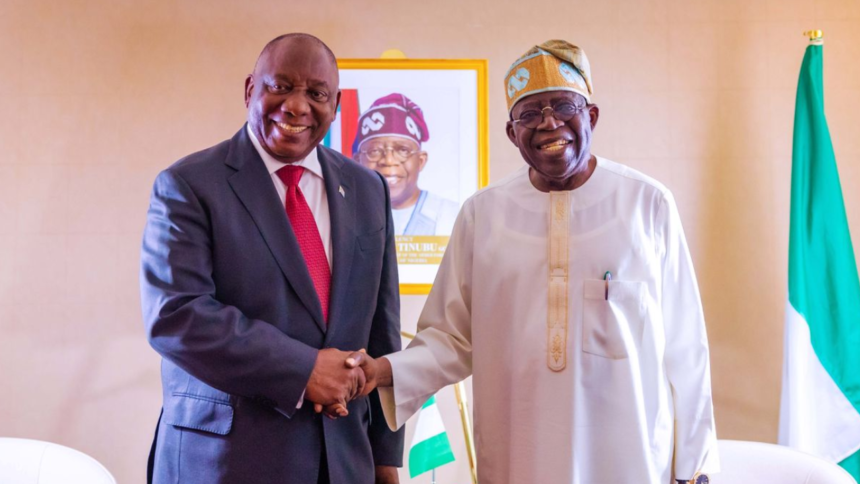
Johannesburg, South Africa – Nigerian President Bola Ahmed Tinubu and South African President Cyril Ramaphosa will meet in November for a business-to-business interaction that will further strengthen the relationship between the two countries.
The meeting is under the auspices of the Bi-National Commission formed in 1999 to strengthen trade and bilateral ties between Nigeria and South Africa.
President Tinubu will discuss business matters that affect both countries, including visa permits for Nigerians traveling to South Africa.
The Nigeria-South Africa relationship was cordial under the leadership of former President Olusegun Obasanjo and former President Thabo Mbeki of South Africa, which led to the formation of the Bi-National Commission between both countries in 1999.
However, the relationship started to lose ground years after both leaders left the stage as presidents, with some incidents leading to the relocation of many South African businesses in Nigeria back to South Africa.
The strained relationship between both countries is currently affecting Nigerians who are regularly denied visas to travel to South Africa.
The meeting will also address other issues, including trade relationships and cross-border financial transactions.
South Africa’s Deputy Minister of International Relations and Cooperation, Mashego Dlamini, confirmed the November Bi-National Commission parley and said it would be an avenue for the two presidents to discuss bilateral trade relations and enter into agreements that will further strengthen the relationship between the two countries.
She said the African Continental Free Trade Agreement (AfCFTA) would also be looked into to enable small businesses to thrive in Africa.
Dlamini urged African journalists to support the African agenda in their reports for peace, security, and unity on the African continent.
“South Africa values the bilateral relationship between Nigeria and South Africa, and we are committed to building relations and strengthening cooperation with African countries and other countries of the world. We consider African countries as strategic in developing the African continent for several reasons,” she said.
“For us, Nigeria is a strategic partner in pursuing mutually beneficial cooperation and development of the African continent. Africa, as a continent, suffers when the relationship between Nigeria and South Africa is not balanced. One of the key pillars of South Africa’s foreign policy is the consolidation and implementation of the African agenda.
“This means that South Africa will continue to support regional integration, and intra-Africa trade and support people-to-people progression, in 2015, the African Union adopted the African Agenda 2063, which intends to build Africa with a strong cultural identity, common heritage, shared values, and ethics and respect for religious diversities.”