


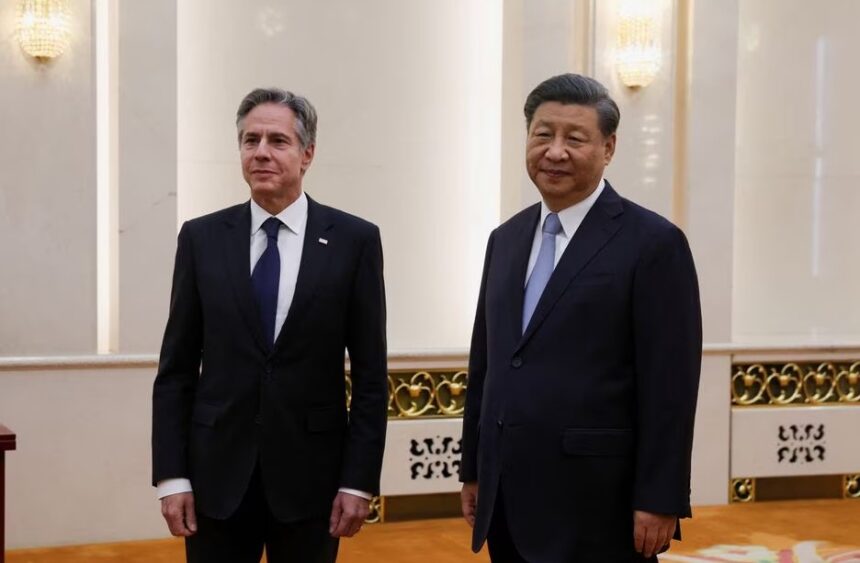
BEIJING, June 19- China and the United States have reached an agreement to prevent their intense rivalry from escalating into conflict, aiming to stabilize their relationship. However, during U.S. Secretary of State Antony Blinken’s visit to Beijing, no major breakthroughs were achieved.
Chinese President Xi Jinping expressed satisfaction with the progress made after a meeting with Blinken at the Great Hall of the People, a prestigious venue typically reserved for greeting heads of state. Both leaders emphasized the importance of maintaining a stable relationship, acknowledging that any conflict between the world’s two largest economies would have far-reaching global consequences.
Despite the shared commitment to stability, China refused to entertain the U.S.’s proposal to resume military-to-military communication channels, citing U.S. sanctions as the main obstacle. The two sides remained entrenched in their positions on various issues, including Taiwan, trade, China’s chip industry, human rights, and Russia’s conflict with Ukraine.
While the visit marked a significant U.S.-China exchange since President Joe Biden assumed office, it remains unclear how the differences between the two nations will be overcome. Nonetheless, they agreed to continue diplomatic engagements and plan more visits in the coming weeks and months.
During a press conference concluding his two-day trip, Blinken stated that the objectives of the visit were achieved. He highlighted raising concerns directly, attempting to establish channels for dialogue, and exploring areas of cooperation. The trip had been postponed in February due to a suspected Chinese spy balloon flying over U.S. airspace.
However, Blinken acknowledged that progress was not straightforward. “The relationship was at a point of instability, and both sides recognized the need to work to stabilize it,” he stated before departing from China. He emphasized that communication and engagement between the two nations would require time and effort.
U.S. officials had managed expectations, downplaying the likelihood of a significant breakthrough in the talks. Nevertheless, they hoped that Blinken’s visit would pave the way for future bilateral meetings, including possible trips by Treasury Secretary Janet Yellen and Commerce Secretary Gina Raimondo. There was even speculation that the visit could lay the groundwork for a summit between Presidents Xi and Biden later this year.
The last meeting between Biden and Xi took place on the sidelines of the G20 summit in Bali, Indonesia in November, during which they pledged to maintain more frequent communication. However, since then, tensions have increased over issues such as Taiwan, espionage allegations, and other concerns.
Both sides claimed to have made progress and reached agreements on certain specific issues, although the details were not specified. Xi informed Blinken that China “hopes to see a sound and steady China-U.S. relationship” and expressed confidence that the two countries could overcome difficulties, according to a Chinese readout of the talks. Xi also warned the United States against infringing on China’s legitimate rights and interests, hinting at potential flashpoints like Taiwan, which Beijing considers its own.
During the talks, Blinken raised contentious issues such as Taiwan, human rights, North Korea’s provocations, and U.S. concerns regarding China’s intelligence activities in Cuba, according to the State Department.
The lack of open communication channels between China and the United States has raised concerns worldwide, and China’s reluctance to engage in regular military-to-military talks with the United States has alarmed its neighbors. Yang Tao, a senior official from China’s foreign ministry, attributed the lack of progress in improving military-to-military communications to U.S. sanctions. He noted that Chinese Foreign Minister Qin Gang had accepted Blinken’s request to visit the United States.
Xi’s comments and the diplomatic choreography surrounding the visit appeared to demonstrate a willingness to make progress, according to analysts. “China’s messaging has been pretty positive,” said Wu Xinbo, a professor and director at the Center for American Studies at Fudan University in Shanghai. “China showed that it still hopes to work with the U.S. to stabilize and improve relations. I think that while China is not optimistic about Sino-U.S. relations, it has not given up hope either.”
Throughout Blinken’s visit, Beijing’s stance on Taiwan remained firm and assertive. “China has no room for compromise or concessions,” stated Wang, as per the Chinese readout. The United States has historically maintained a policy of “strategic ambiguity” regarding its response to an attack on Taiwan, an issue Beijing refuses to rule out.