


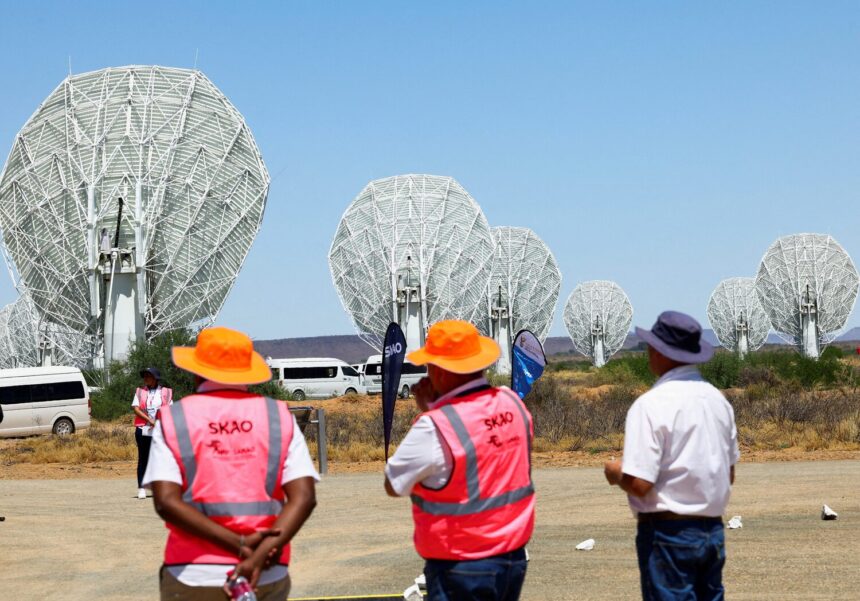
CAPE TOWN, June 2 — Astronomers behind South Africa’s Square Kilometre Array (SKA) telescope are raising concerns that Elon Musk’s Starlink satellite network could interfere with the observatory’s ability to detect distant signals from space. As talks continue to bring Starlink to South Africa, scientists are urging that any licensing agreements include strict protections for astronomical research.
The SKA Observatory, based in the Northern Cape, is part of a global project alongside Australia and hosts the world’s most powerful radio telescope array. Researchers fear the signals from Starlink’s low-orbit satellites could drown out the faint radio waves from celestial objects, disrupting critical scientific work.
“It’s like shining a spotlight into someone’s eyes — it blinds us to the subtle signals we’re trying to detect,” said Federico Di Vruno, spectrum manager at SKA and co-chair of the International Astronomical Union’s Centre for the Protection of the Dark and Quiet Sky.
Di Vruno explained that SKA and South Africa’s Radio Astronomy Observatory (SARAO) are pushing for technical restrictions in Starlink’s license to limit interference. These may include diverting satellite beams away from the telescope or briefly halting transmissions when satellites pass over sensitive areas.
The SKA antennas in Carnarvon currently operate within the 350 MHz to 15.4 GHz spectrum — a range widely used by satellite operators. That overlap has prompted concerns that unregulated transmissions could undermine the observatory’s potential for breakthrough discoveries.
The Independent Communications Authority of South Africa and Starlink’s parent company, SpaceX, have not commented on the concerns. SpaceX has previously clashed with South African regulators over local ownership rules, which the company claims are an obstacle to launching Starlink in the country.
Despite that, the government has maintained it will not abandon its economic transformation policies, rooted in post-apartheid reforms aimed at increasing Black ownership in key sectors.
South Africa’s MeerKAT telescope, which is a precursor to the full SKA array, has already uncovered significant findings — including a rare giant radio galaxy 32 times the size of the Milky Way and 49 new galaxies discovered in a single afternoon.
The SKA Observatory is also lobbying for similar protections in licensing deals with other global satellite providers, such as Amazon’s Kuiper project and OneWeb, as satellite deployments continue to rise worldwide.
“We’re pursuing both technical and regulatory solutions globally to ensure the skies remain quiet enough for science,” Di Vruno said.