

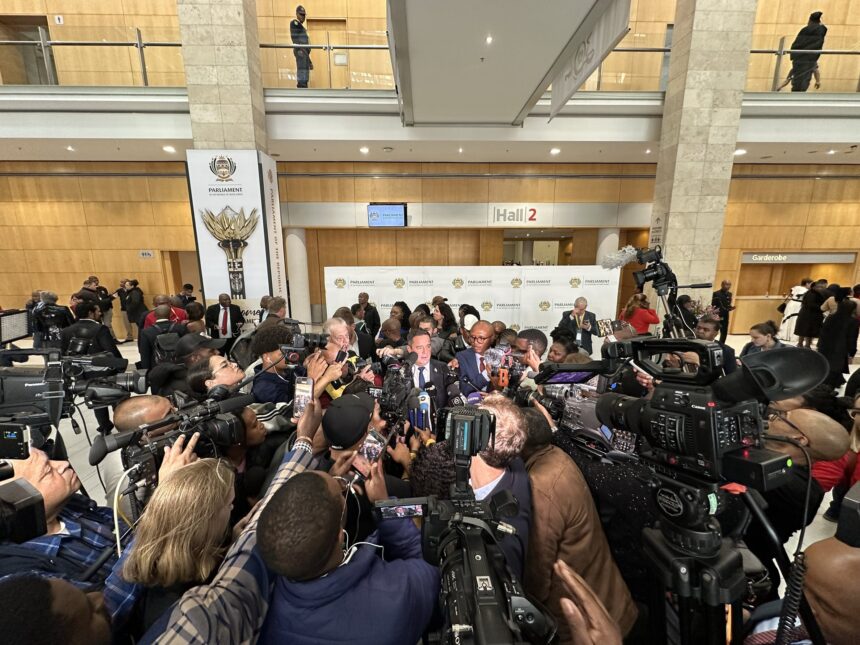
CAPE TOWN, South Africa, June 14 – South Africa’s African National Congress (ANC) has forged an alliance with the Democratic Alliance (DA), its long-time rival, to establish a new government of national unity. This landmark coalition marks the first time in 30 years that the ANC has shared power, following its recent loss of majority in the May 29 election.
The agreement between the ANC and the DA, a pro-business party traditionally led by white South Africans, represents a significant transformation in the nation’s political landscape. Not since Nelson Mandela’s historic 1994 election victory, which ended apartheid, has South Africa seen such a momentous political development.
“Today, South Africa is a better country than it was yesterday,” declared DA leader John Steenhuisen in a televised address. He emphasized that this marks the beginning of a new era of multi-party governance in the country.
The ANC, having lost its majority for the first time, engaged in two weeks of intense negotiations with various parties, culminating in Friday morning’s agreement as the new parliament convened. ANC Secretary-General Fikile Mbalula highlighted that this coalition aims to benefit the country by uniting executive and legislative efforts.
The ANC’s declining support is attributed to persistent issues such as poverty, inequality, crime, power outages, and internal corruption. This new alliance is seen as a pivotal moment for a nation still grappling with the legacy of apartheid and colonialism.
The DA proposes to dismantle some of the ANC’s Black empowerment programs, criticizing them for benefiting a politically connected elite rather than the broader population. Despite accusations from opponents like the Economic Freedom Fighters (EFF) of serving white minority interests, some view the coalition’s racial dynamics as a potential strength.
The new National Assembly in Cape Town elected the ANC’s Thoko Didiza as its speaker, with subsequent elections for deputy speaker and head of state expected. President Cyril Ramaphosa is anticipated to secure a new term with coalition support. According to a DA source, the party is set to receive the deputy speaker post.
The ANC secured 159 of 400 seats, the DA 87, Jacob Zuma’s uMkhonto we Sizwe (MK) 58, the EFF 39, and the Inkatha Freedom Party (IFP) 17. The inclusion of the IFP, appealing to the ethnic Zulu base, may help ease acceptance of the DA among ANC voters. The Patriotic Alliance represents the coloured (mixed-race) community.
A document outlining the coalition’s priorities emphasizes economic growth, investment promotion, job creation, land reform, infrastructure development, and fiscal sustainability. Investors have reacted positively, expecting policy continuity or accelerated reforms.
Despite MK’s third-place finish, the party is boycotting the new parliament, alleging election fraud. In a notable development, an IFP official was elected premier of KwaZulu-Natal province with support from the DA, ANC, and another party, defeating the MK candidate. Analysts warn that excluding MK from the provincial government, despite their electoral success, might lead to unrest in the region.