




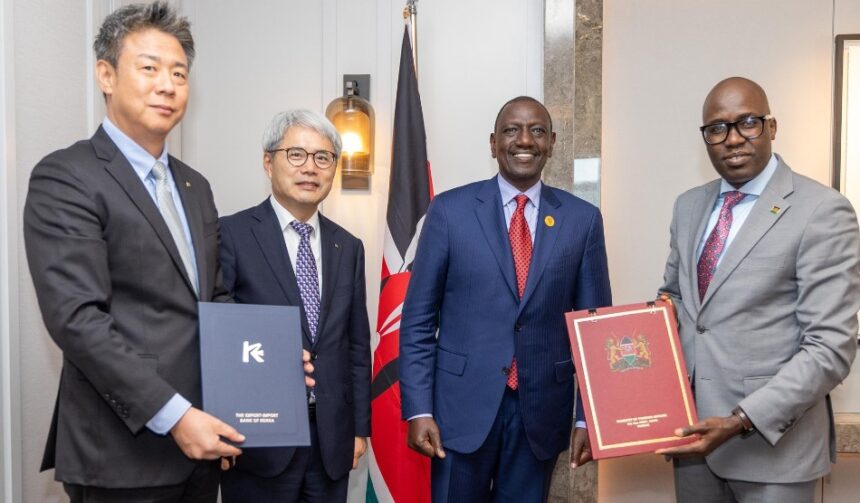
Goyang, South Korea – June 4, 2024 – Kenya and South Korea signed a significant agreement worth $485 million (KSh63 billion) on the sidelines of the ongoing Korea-Africa Summit. This concessional development funding will fuel several key projects in Kenya, with a strong focus on digital innovation.
A major highlight of the deal is a $238 million (KSh30 billion) allocation for the Konza Digital Media City Project. Kenyan President William Ruto hailed the project as a game-changer for the country’s digital ecosystem. He envisions Konza Technopolis becoming a hub for research, training, and the adoption of cutting-edge technologies, ultimately creating new opportunities for Kenya’s young people in the digital and creative economy.
President Ruto expressed his appreciation for Korea’s continued support, particularly through the Economic Innovation Partnership Programme, which further bolsters Konza Technopolis.
The two leaders also discussed the nearing completion of the Kenya Advanced Institute of Science and Technology (KENYA-AIST), modeled after Korea’s own successful science and technology institute. President Ruto extended an invitation to President Yoon Suk Yeol to attend the official opening of KENYA-AIST later this year, emphasizing the institute’s potential as a symbol of strengthened scientific and technological collaboration between Africa and Korea.
Beyond the digital realm, the discussions highlighted ongoing joint projects between the two nations. These include infrastructure development initiatives like Bus Rapid Transit Line 5, the Nairobi ITS, and the expansion of the Machakos Junction-Emali Road. Additionally, water supply and sanitation projects for Konza Technopolis and a collaborative Vaccine Production Project were mentioned.
President Ruto also urged the fast-tracking of the Kenya-Korea Bilateral Labour Agreement, seeking to ensure a smooth and legal experience for Kenyan workers in Korea.
Trade relations were another key topic. President Ruto acknowledged the current imbalance favoring Korea but expressed optimism about working together to achieve a more balanced exchange. He identified areas like maritime development, green industrialization, and manufacturing as potential areas for increased cooperation.
Kenya’s aspirations to become a leader in African manufacturing and technology were also on the table. President Ruto specifically requested Korean expertise in developing the semiconductor industry through partnerships, infrastructure development, and capacity building. He further highlighted Kenya’s interest in exploring nuclear energy as part of its plan to expand its renewable energy mix and meet growing energy demands.
President Yoon responded positively, pledging Korea’s commitment to strengthening ties with Kenya and supporting the country’s ambitious agenda in technology, infrastructure, water management, and dam construction projects.


