


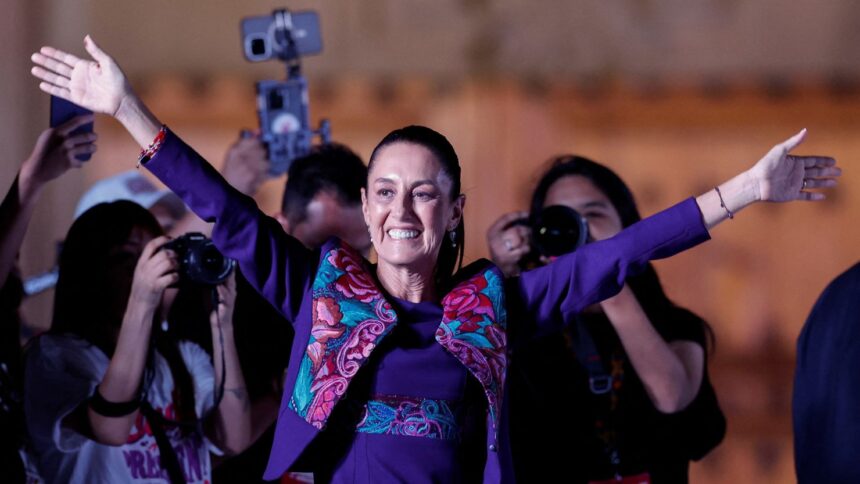
MEXICO CITY, June 3 – Claudia Sheinbaum made history by winning a landslide victory to become Mexico’s first female president, securing 58.8% of the vote with 82% of ballots counted. Her victory, the largest in Mexico’s democratic history, has sparked market jitters due to concerns about potential unchecked constitutional reforms by her party’s ruling coalition.
Sheinbaum, a former Mexico City mayor and climate scientist, expressed gratitude to outgoing President Andres Manuel Lopez Obrador in her victory speech, acknowledging his transformative influence on the country. Her win is a significant milestone for Mexico, a nation with a deeply ingrained macho culture and a large Roman Catholic population.
However, investors are wary of the ruling coalition’s possible congressional super-majority, which could allow controversial reforms, particularly in the energy sector. This uncertainty led to a 3.4% drop in the Mexican peso against the dollar and a 5% fall in the stock market by Monday morning.
Luis Maria Alcalde, the interior minister, confirmed that while the Morena party secured a super-majority in the lower house, it fell a few seats short in the Senate. Despite this, some constitutional changes could still be achieved with minimal opposition support.
Market concerns are rooted in Lopez Obrador’s proposed reforms, including pension increases, mandatory minimum wage hikes, and the abolition of regulatory bodies. Although previously rejected by lawmakers, investors fear Sheinbaum might pursue these changes. Analysts noted her commitment to continuing Lopez Obrador’s policies, while also asserting her independence.
Lopez Obrador, who remains influential, plans to collaborate with Sheinbaum on key reforms during his remaining tenure, emphasizing cooperation. He expressed a desire to align with Sheinbaum on initiatives without imposing his views.
Despite Lopez Obrador’s successes in reducing poverty, doubling the minimum wage, and maintaining a strong peso, analysts predict Sheinbaum will face challenges in maintaining his legacy. Her victory speech included a commitment to expanding welfare policies and improving security, though specifics were not provided.
The election, marked by significant violence with 38 candidates murdered, highlights Mexico’s crime issues. Over 185,000 people have been killed during Lopez Obrador’s administration, although the homicide rate has slightly decreased recently.
Internationally, U.S. President Joe Biden congratulated Sheinbaum on her historic win. She will need to navigate complex negotiations with the U.S. regarding migration and drug trafficking, particularly as the fentanyl crisis escalates. Mexican officials anticipate tougher talks if Donald Trump wins the U.S. presidency, given his hardline stance on tariffs and cartel combat.
Domestically, Sheinbaum must address electricity and water shortages and attract manufacturers as part of the nearshoring trend. Additionally, she must determine the future of Pemex, the debt-ridden state oil company with declining production.
“Pemex cannot continue as an endless pit for public funds without profitability,” said Alberto Ramos, Chief Latin America Economist at Goldman Sachs. “A new business model is essential.”